
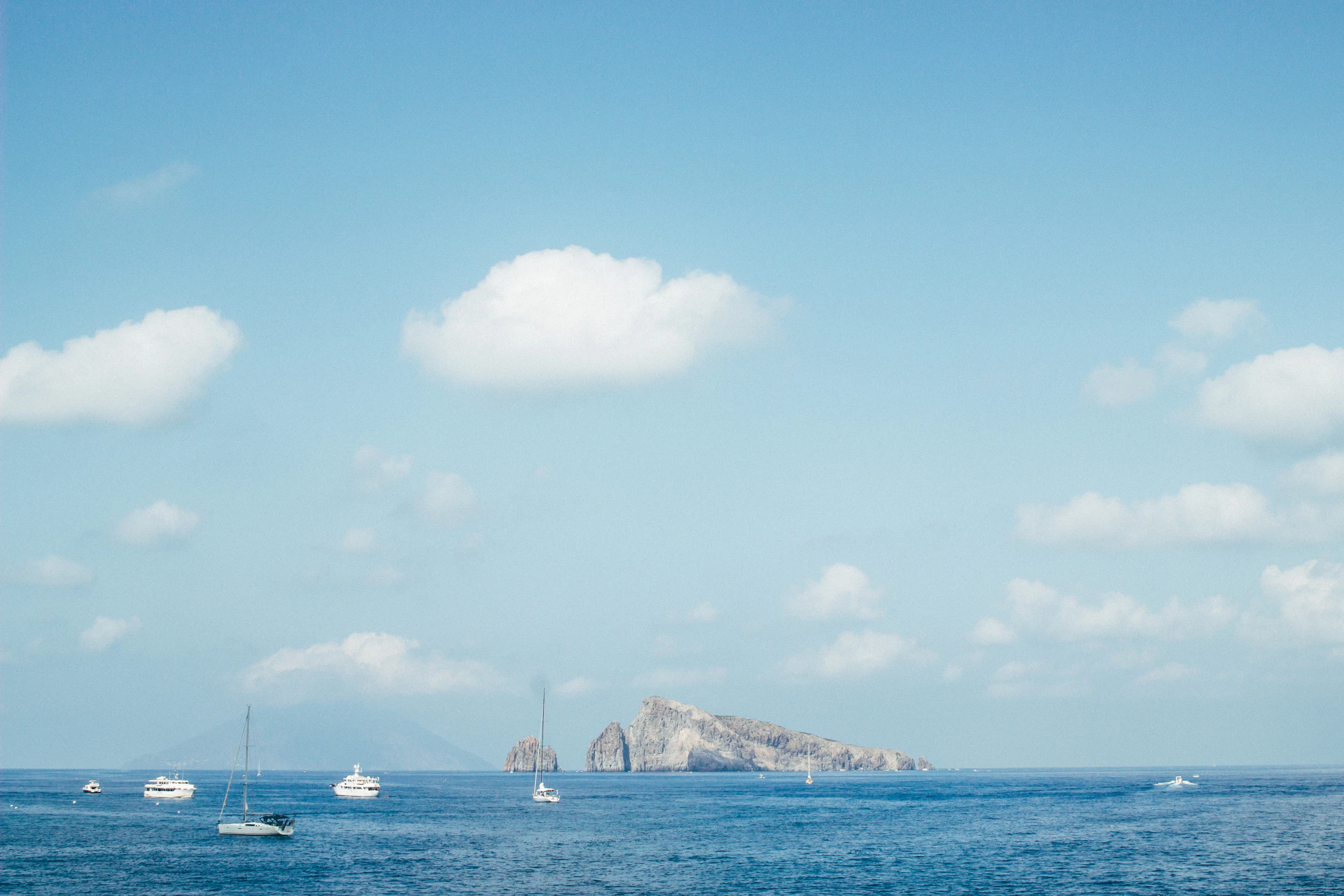
Places
The Aeolian Islands by Boat: Panarea, Stromboli, Lipari and Vulcano
Seven volcanic islands off Sicily's north coast, an active volcano that erupts on a timetable, and why the archipelago reads completely differently from the deck of a boat than it does from a ferry.
The Aeolian Islands by Boat: Panarea, Stromboli, Lipari and Vulcano
Destination
Sicily
Category
Places
North of Sicily, out past the top of the Ionian coast, seven volcanic islands sit in deep blue water with nothing much around them.
The Aeolian Islands are a UNESCO World Heritage site, and they are volcanic in the most literal available sense — this is not an archipelago that happens to have volcanoes on it, it is an archipelago made of them, one of which has been erupting more or less continuously for longer than anyone has been keeping records.
Ferries run here. They are fine, and they take you to a harbour and leave you there. The islands are small, the harbours are the least interesting part of them, and almost everything worth seeing sits on a coastline that a scheduled boat has no reason to slow down for. Which is the argument for arriving in something that can stop.
Panarea
The smallest of the seven, and the one with the reputation.
Panarea has no cars in any meaningful sense — the island runs on electric carts and walking — and the village is low, whitewashed and built into the slope above the water. It is the most fashionable of the Aeolians and manages to be so without being large: the whole island is a few square kilometres.
From a boat the draw is not the village but what surrounds it. Cala Junco on the southeastern side is a near-perfect horseshoe cove enclosed by rock, with a Bronze Age settlement on the headland above it, and water in the middle that turns an improbable green over the pale bottom. It is a swimming stop of the kind that justifies a crossing on its own.
Off the island's eastern side stands Basiluzzo, a flat-topped rock rising sheer out of deep water with the remains of a Roman villa on its summit. Boats anchor in the channel between it and Panarea, which is one of the more theatrical places in the Mediterranean to get in the water.
Stromboli
An active volcano rising straight out of the sea, and the reason a lot of people come north at all.
Stromboli produces small, frequent eruptions — the behaviour is common enough that volcanologists named it after the mountain. On the northwestern flank the Sciara del Fuoco, a vast dark scar of loose material, runs from near the summit all the way into the water. Ejected rock rolls down it. From the sea, at dusk, you watch the summit throw and the glow travel down the slope.
This is the single strongest reason to be here on a boat rather than a ferry, because the view that matters is the one from the water off the Sciara, in the dark, with the engine off. There is no version of that available from a harbour, and the timing is unforgiving — you need to be in position as the light goes, not on your way there.
Activity varies, and periods of heightened activity bring exclusion zones. It is a live volcano, not an attraction, and how close is sensible on any given evening is a question for a captain who has been watching it all season.
Lipari
The largest island, and the one that functions as the archipelago's centre.
Lipari has a proper town, a castle on a headland, and a coastline that changes completely as you work around it. The west side has the pumice and obsidian country — pale white quarry slopes running into water that goes an unnaturally bright turquoise where the pumice dust sits on the bottom. The stacks off the southwestern coast, and the sea caves along it, are boat-only.
It is the practical island: the one where a longer trip can reprovision, and where there is enough ashore to make landing worthwhile.
Vulcano
The closest of the group to Sicily, and the most obviously geothermal.
Vulcano has fumaroles venting sulphur around its crater and along parts of the shore, black sand beaches, and warm water bubbling up in places where the seabed is still venting. The smell is real and people are divided about it. The landscape is genuinely otherworldly — raw yellow mineral crust, black sand, and the crater rim above.
Salina, Filicudi and Alicudi
The three quieter ones, and worth knowing exist.
Salina is the green island — twin volcanic cones, terraced vines, noticeably more vegetation than its neighbours. Filicudi and Alicudi are further west, progressively smaller and progressively emptier, and Alicudi in particular has almost no roads and very few residents. They are a long way out, and they are the part of the archipelago most people never see.
Getting There
The Aeolians are a real passage from Sicily's Ionian coast, not a coastal hop. From Taormina the run north is a couple of hours in a fast motor yacht in settled conditions, and it commits you to a full day rather than an afternoon.
That is worth being clear about, because the crossing is the thing that makes the day work or not. In good conditions it is a straightforward run. In a building sea it is the part of the plan that changes, and a captain who calls it early is doing the job properly.
Planning a Day
The season runs late spring to September, and the Aeolians are at their best when the sea is settled and the light is long — which in practice means June through early September.
Ahoy Days lists instant-book day boats out of Taormina, from four hours upward, with the Aeolian run as a full-day option. Every listing shows a live from-rate and its licensed capacity, and books online. If Stromboli at dusk is what you want out of the day, say so when you book — the whole schedule is built backwards from where you need to be when the light drops.
Ready to plan the best day of your holiday?
Browse our fleet of luxury yachts and start planning your Mediterranean escape.
Browse Available Yachts