
Places
Sicily's Best Swim Stops You Can Only Reach by Boat
The coves, grottos and rock stacks along Sicily's Ionian coast that a hire car can never get you to — and how a day boat out of Taormina strings them together.
Sicily's Best Swim Stops You Can Only Reach by Boat
Destination
Sicily
Category
Places
Sicily has a coast road, and it is a beautiful one. It also spends most of its length a hundred metres above the water, separated from every cove worth swimming in by a cliff, a railway line and somebody else's hotel.
That is the whole case for seeing this stretch from a boat. The Ionian coast below Taormina is a series of small bays, sea caves and limestone stacks, and the good ones are either genuinely unreachable on foot or reachable in a way that involves a long stair, a paid gate and a crowd. From the water they are simply where you stop.
These are the places worth building a day around.
Isola Bella
The one everybody photographs from the terrace at Taormina, and the one almost nobody experiences properly.
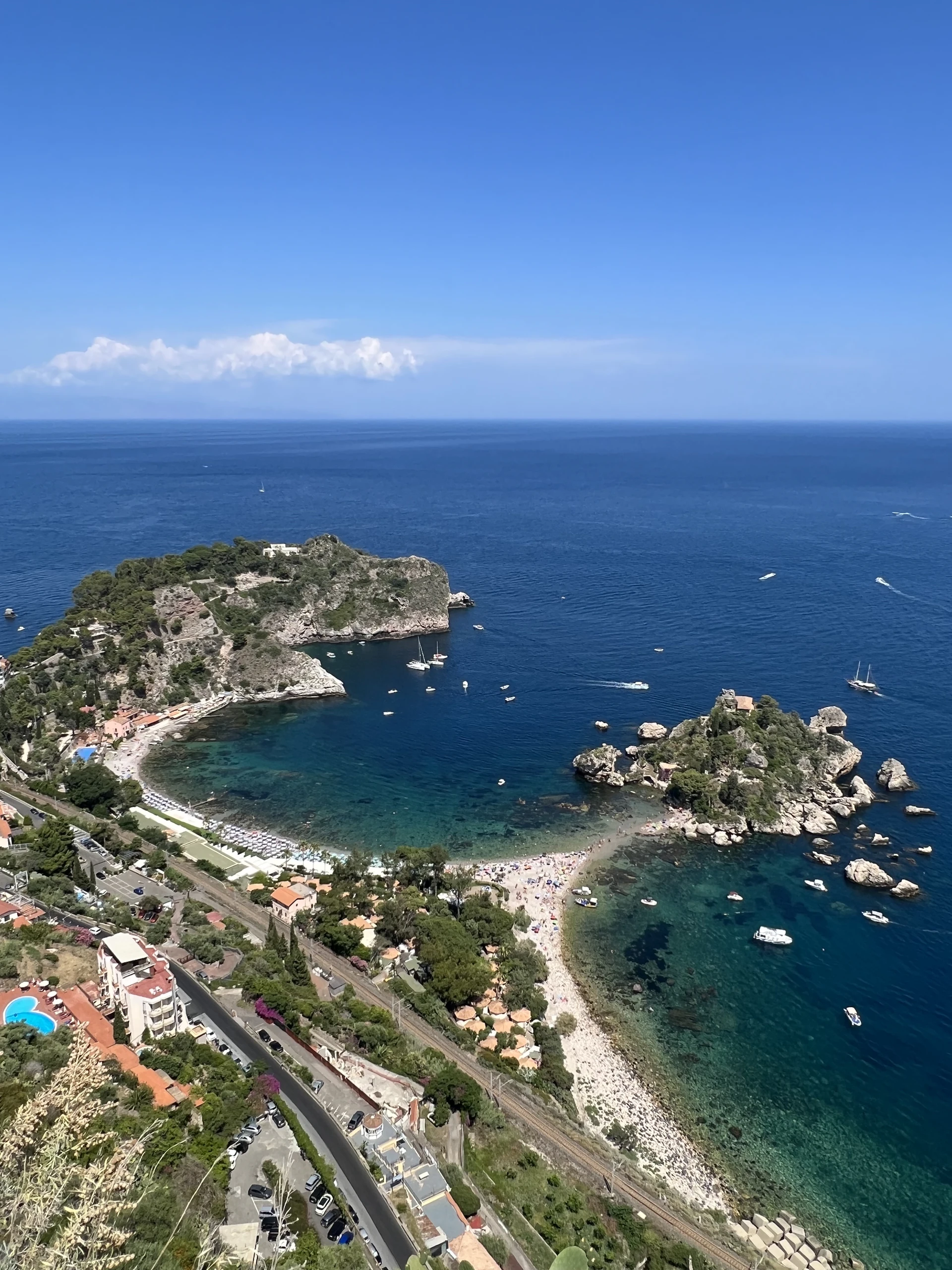
Isola Bella is a small wooded islet sitting a few metres off the beach in the bay below town, joined to the shore by a narrow spit of pebbles that appears and disappears with the sea state. It is a protected nature reserve, and the water around it is the clearest on this part of the coast — pale green over the shallow shelf near the isthmus, dropping to deep blue on the seaward side.
From land you get the beach, the crowd and the view of the island. From a boat you get the other three sides of it: the rock faces, the small caves cut into its base, and water clear enough that the bottom stays visible well past swimming depth.
Anchoring inside a marine reserve is regulated, and where exactly a boat can sit depends on the reserve's zoning and the day's conditions. That is a captain's problem rather than yours, and a local one will know it without being asked.
The Grottos Below Capo Sant'Andrea
The headland that closes the southern end of the Taormina bay is undercut with sea caves.
The best known is the blue grotto below Capo Sant'Andrea, where the light entering underwater throws the same electric colour onto the cave walls that Capri is famous for. It is smaller and far less ceremonial than its Campanian cousin, which is rather the point — there is no queue of tenders, no ticket, no schedule.
The caves along this headland only work from the water, and only in settled conditions. Any swell running into the rock closes them off entirely. On the right morning they are the single most striking thing on this coastline.
Baia delle Sirene
Just around from Isola Bella, tucked under the same headland, the Bay of the Sirens is a small horseshoe of deep water against a rock wall.
It is a swimming stop rather than a beach — there is very little to land on and no real reason to. Boats hold off the rock, people get in, and the whole thing has the pleasant quality of somewhere that exists only if you arrived by sea. The name is doing exactly the work you would expect on a coastline the Odyssey has been claiming for three thousand years.
The Bay at Giardini Naxos
South of Taormina the cliffs relax into a long, open bay, and the water changes character with them.
Giardini Naxos is the site of the first Greek colony in Sicily, founded in the eighth century BC, and it sits on a wide crescent of sheltered water that behaves quite differently to the rocky coast immediately north. It is calmer, shallower and warmer, and it is usually the sensible answer when the sea north of the headland is up.
It also has a waterfront, which matters on a longer day — this is the stretch of coast where a boat can put people ashore rather than simply anchoring off rock.
The Cyclops Rocks at Aci Trezza
Further south again, past Acireale, a cluster of black basalt stacks stands out of the water off the village of Aci Trezza.
These are the Faraglioni dei Ciclopi — the rocks that Polyphemus, in the story, hurled after Odysseus as he escaped. They are volcanic, thrown up by the same system that built Etna behind them, and they are startlingly abrupt: sheer black columns straight out of blue water with nothing gradual about them.
It is a long run south from Taormina and it will not fit into a half day. On a full day, with settled sea, it is one of the more dramatic anchorages in Sicily and a completely different landscape to the limestone north of Taormina.
What Ties It Together
Etna.
The volcano is behind this entire coastline, and from the water it is unavoidable in the best way — a snow-streaked mass standing over every one of these bays, changing colour through the day and occasionally trailing a plume off the summit. On land it is something you drive to. From a boat it is simply the backdrop to lunch.
That is the honest argument for doing this coast by sea rather than by car. Not that the stops are secret, but that they connect. A hire car gives you Isola Bella, a car park and a stair. A boat gives you Isola Bella, the caves around the corner, a swim in deep water off a rock wall, and a slow run south with a volcano over your shoulder — in the order the weather suggests rather than the order the road allows.
Planning a Day
The Sicilian season runs from late spring into September, with the warmest water and the longest light through July and August. June and September tend to give the better combination: sea that has held its heat, and far less traffic in the bays.
Ahoy Days lists real, instant-book day boats out of Taormina, all of them motor yachts and all bookable from four hours upward. Every listing shows a live from-rate, its licensed guest capacity and what is included, and books online without a broker in the middle. Pick the boat and the date; leave the running order of the coves to the captain and the morning's conditions.
Ready to plan the best day of your holiday?
Browse our fleet of luxury yachts and start planning your Mediterranean escape.
Browse Available Yachts